Overview
Our BA (Hons) Animation degree is designed for creative students who want to develop their passion for 2D animation into a professional career. This flexible and inclusive course supports a wide range of creative approaches, encouraging you find your own ways of working and gain the skills needed to thrive in the industry, whether that be as an animator, storyboard artist, character designer, rigger, layout artist or independent filmmaker or related field.
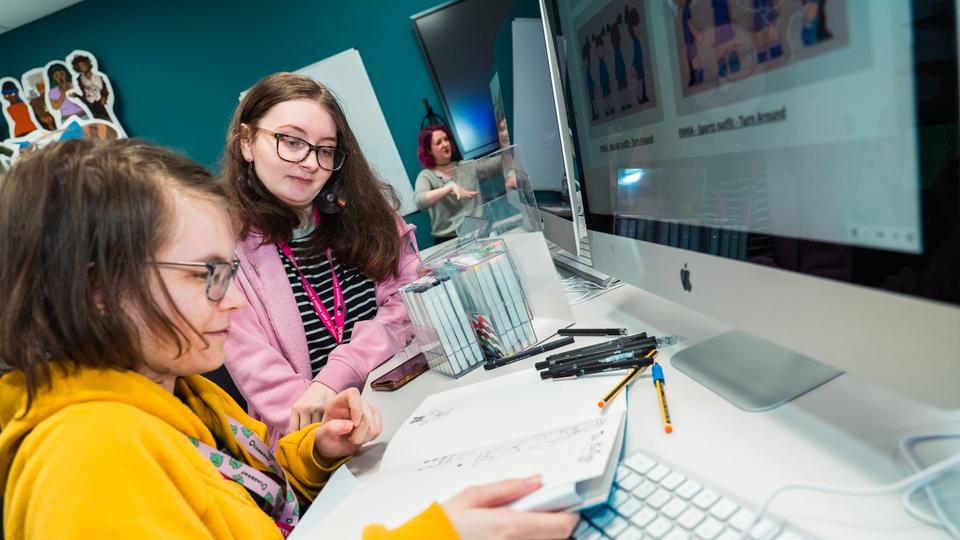
From the beginning, you will work with the tools and used by contemporary studios, such as Toon Boom Harmony, Moho and the Adobe Creative Suite. Modules will allow you to develop confidence in 2D character performance, design principles, digital art, storytelling, and the production processes that underpin professional animation. You will create polished sequences and explore visual styles across multiple stages of animation production.
Year 1 focuses on skills. You will learn the fundamentals of animation, motion and storytelling while strengthening your artistic ability and software skills. This lays the foundations that will guide the rest of your development.
Year 2 encourages you to expand your abilities and personal practice. You will explore specialist areas such as character design, client work, scene layout and motion design. A self-directed creative project also gives you space to experiment and begin forming a portfolio that reflects your individual style.
Year 3, allows you to refine your specialism. For the major project you will produce a substantial body of work that showcases your creativity and skill. You will develop a professional portfolio supported by staff with industry experience.
During the course workshops and regular feedback will help you grow as an animator. Industry engagement offers valuable insight, so by graduation, you will have a distinctive portfolio and a clear understanding of industry workflows and the confidence to progress into animation.
- City Campus Manchester
- Full Time
- 3 years
- September 2026

Staff profile
Katy Rushton is Programme Leader for the Animation degree and also lectures on the BA (Hons) 3D Game Art & Design. With over 16 years’ experience in creative education, she is a Fellow of the Higher Education Academy and a member of the Society for Animation Studies. Katy holds an MA in Sequential Design and Illustration from the University of Brighton. Katy has presented at the Educating Animators conference at Manchester Animation Festival and sits on the Motion North steering group.
Her professional animation experience includes model making for Mackinnon and Saunders on Tim Burton’s Corpse Bride and recent freelance work on the award-winning BFI short Two Black Boys in Paradise.
Ben Elson is Programme Leader for the BA (Hons) 3D Game Art & Design with over 17 years in further and higher education. His industry expertise spans technical art and digital production pipelines. Ben is also Assistant Training Manager for 3D Game Art with WorldSkills UK, mentoring competitors nationally and internationally, including WorldSkills Lyon 2024. He additionally leads the National Graphic Design Competition.
Emily Young Chapman is a freelance artist specialising in character and creature design. An alumnus of UCEN Manchester, she has produced concept work for studios including Supermassive Games on Little Nightmares 3 and Flipbook Studio, alongside international clients. She has been recognised by the Concept Art Association and continues to expand her practice through advanced courses with Brainstorm School.
Joshua Probert is a specialist technician engaged in ongoing research within Animation and 3D Game Art, focusing on production pipelines, He supports curriculum development through his exploration of emerging tools and industry workflows. Josh has published several titles and regularly runs Game Jams, enabling students to develop skills informed by current industry practice.
Academic Entry Requirements
• 64 UCAS Tariff Points
• Full level 3 qualification in a relevant subject
• If English is not your first language, you will need an IELTS score of 6.5 with a minimum of 5.5 in all skills, or equivalent.
• We strongly recommend that all applicants have GCSE English Language and Mathematics grades A*-C or level 9-4.
Non-Academic Entry Requirements
Applicants from outside the specific subject area may be asked to submit a portfolio or attend an interview demonstrating their suitability for the programme.
Mature applicants (aged 21 or over) who may not hold a qualification, that can demonstrate relevant skills or knowledge gained in employment or vocational activity, will be considered and may be invited to interview.
UCEN Manchester is unable to consider international applications due to UKVI regulations.
What will I be studying
Year 1: Animation Principles (20 credits)
This module focuses on the 12 principles of animation and how they are used to create convincing, expressive movement. You will analyse professional examples and apply each principle through short exercises using traditional and digital tools. The aim is to build strong foundational skills that support movement, timing and visual storytelling.
Year 1: Design Fundamentals for Animation (20 credits)
This module introduces the core visual foundations of animation, including composition, colour theory, shape language, and visual communication. You will learn how design choices influence character, mood and narrative, and develop practical skills through drawing, digital workflows and exploratory design tasks. The module builds confidence in applying design principles across different animation contexts.
Year 1: Introduction to Animation (20 credits)
You will explore the history, techniques and terminology of animation, gaining an understanding of industry practices and production pipelines. Through hands-on workshops, you will experiment with a range of traditional and digital methods, preparing you for further practical study by establishing essential knowledge and technical awareness.
Year 1: Introduction to Motion Design (20 credits)
This module provides an introduction to motion graphics and animated visual communication. You will experiment with typography, graphical elements and dynamic layouts to create short motion sequences. The module will help you explore the relationship between animation, design and digital media.
Year 1: Rigging for 2D Animation (20 credits)
This module introduces digital rigging techniques for 2D character animation. You will explore hierarchy, bone structures, pivots and controls used to prepare assets for efficient movement. Working with industry-standard software, you will learn how to build flexible rigs suitable for a range of animation styles and production needs.
Year 1: Storyboarding (20 credits)
You will learn how to translate ideas into clear visual narratives through storyboarding. The module covers narrative, shot types, transitions and composition. Using industry workflows, you will create storyboard sequences that communicate action, intention and emotion in preparation for animated production.
Year 2: 2D Character Design for Animation (20 credits)
Focusing on character creation, this module explores shape language, appeal, expression and functional design. You will produce character sheets, turnarounds and expression tests while considering how design elements support performance and storytelling. The module strengthens your ability to create characters suitable for professional production pipelines.
Year 2: Animation Practices (20 credits)
This module develops your technical and creative skills through a series of practical animation tasks. You will refine your understanding of performance, timing and movement while experimenting with styles and workflows. Emphasis is placed on problem-solving and building confidence in producing longer and more complex animated work.
Year 2: Background and Layout (20 credits)
This module examines the role of environments, layouts and staging in animation. You will study perspective, lighting, colour and cinematic composition to design backgrounds that support narrative and character action. Practical tasks help you create production-ready layout artwork using digital and traditional processes.
Year 2: Client Set Project (20 credits)
You will work on a live or simulated client brief, responding to professional expectations and collaborative processes. The module develops your ability to communicate ideas, manage feedback and produce work to specified requirements. It provides insight into industry workflows and encourages adaptability in creative problem-solving.
Year 2: Creative Animation Project (20 credits)
This module offers the opportunity to develop an extended piece of work that reflects your interests and personal style. You will take a project from concept to final animation, managing planning, production and refinement. The module encourages creative independence and prepares you for more specialised study at Level 6.
Year 2: Motion Design Practices (20 credits)
Building on your previous experience, this module expands your motion graphics skills through more advanced workflows. You will explore typography, transitions and design-led animation. The focus is on professional techniques used in digital media and contemporary motion design.
Year 3: Animation Portfolio (20 credits)
This module guides you in producing a polished, industry-ready portfolio or showreel. You will curate your best work, revise key pieces and present your skills to potential employers or clients. The aim is to showcase your creative strengths clearly and professionally.
Year 3: Major Animation Project (40 credits)
The final major project is a substantial piece or collection of animated work that reflects your specialist interests and showcases your creative identity. You will manage all phases of production, from concept and development through to final delivery. This module demonstrates your ability to produce high-quality, independent work at a professional standard.
Year 3: Professional Development for Animation (20 credits)
This module prepares you for employment by focusing on industry roles, networking, self-promotion and career planning. You will review your skills, build professional documentation and develop strategies for entering the animation sector. The module supports your transition into freelance, studio or postgraduate pathways.
Year 3: Specialist Animation Investigation (40 credits)
You will undertake a self-directed investigation into a specialist area of animation, such as character animation, motion design, visual development or experimental practice. Through research and practical exploration, you will refine your technical approach and define the focus of your final-year work.
How will I be assessed?
Assessment on the animation degree is designed to reflect the creative expectations of the professional animation and freelance industries. The course focuses on practical, hands-on project work that allows students to develop confidence, technical skill, and a strong portfolio. From the start, students are encouraged to think and work like professional animators, responding to briefs that mirror real industry tasks in areas such as animation, rigging, digital art, motion design, storytelling, and character design.
Assessment emphasises both creative output and the thinking behind artistic decisions. Students demonstrate their abilities using industry-standard software. Whether producing animations, designing sequences, creating assets, or developing storyboards, students are assessed on craft, intention, and problem-solving.
Reflective practice forms an essential part of assessment. Students document their processes, analyse reference material, and evaluate their development over time. This nurtures critical thinking and strengthens their understanding of professional workflows.
As students’ progress, assessment becomes increasingly geared toward portfolio development. Each project contributes to an industry-ready body of work that highlights the student’s strengths and specialist direction. Feedback is continuous and constructive, with tutorials, critiques, and industry-style reviews helping students refine their skills and presentation.
Assessment is flexible and inclusive, allowing students to explain their processes in formats that suit their communication preferences be that written, visual, verbal, and/or multimedia, ensuring everyone can demonstrate their learning effectively.
In the final year, students take greater ownership of their practice by focusing on a chosen pathway, culminating in a major project that showcases their abilities and prepares them for employment in the animation industry and beyond.
Course Associated Costs
All the books required for the course are available from the library and you will have access to industry standard computers and software on campus with licences for the main software programmes to install at home.
You may choose to buy some of the core textbooks for the course and/or a computer which is highly recommended.
Estimated costs for an appropriate laptop/desktop starts at around £900. Please speak with your course tutor for advice on buying computers/equipment.
You will be provided with Wacom drawing tablets in class but my want to purchase one of your own. Prices start at around £40 for the cheapest model, other brands are available.
A set of drawing/art materials and sketchbook will be provided on class but is also advisable to have your own materials for concept development.
Teaching materials are provided online, and assignments are submitted electronically.
However, you might also wish to print other documents. Campus printing costs start from 5p per page.
All students are subject to UCEN Manchester’s Terms and Conditions from the date they accept an offer to study here. The UCEN Manchester Admissions Policy and Procedure can be found here.